Differentiation.
It's a warm summer evening in ancient Greece...
::: author Apollonius of Perga 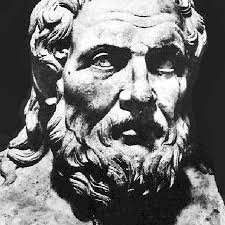 A tangent to a curve C is a line l that intersects C, such that no other line could fall between l and C. :::
Finding the tangent Using a limit.
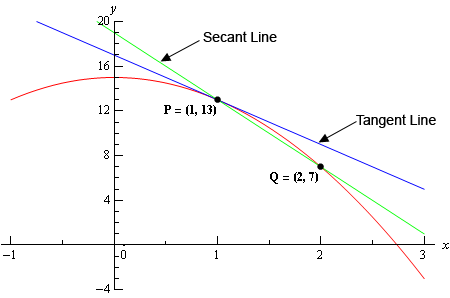
- the line through P an Q is called a secant.
- the tangent to the curve (at P) is the limit of the secant line for Q approaching P.
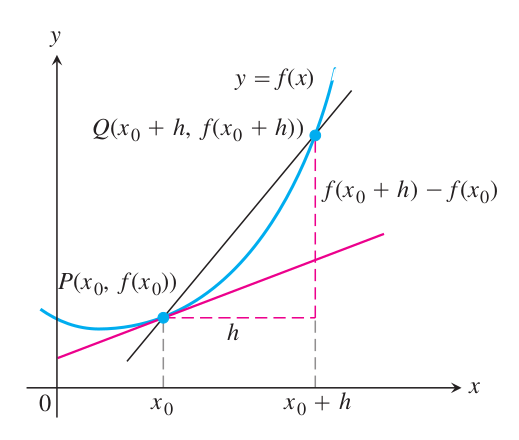
- the slope of the secant through P and Q is:
- The slope of the tangent to C at P is
Differentiability and continuity
Definition
Let f be a function defined on an open interval I, and let
provided this limit exists.
If the limit exists we say: f is differentiable at
When a function is differentiable it is also continuous.
But a function can be continuous but not differentiable.
Possible notations for derivatives:
Differentiation Rules 📜
- Sum Rule:
- Difference Rule:
- Constant multiple Rule:
- Product Rule:
- Quotient Rule:
- Chain Rule:
Derivatives of elementary functions:
| condition | ||
|---|---|---|
| c | 0 | |
The tangent Line:
info
Let f be differentiable at a. The tangent line to the graph of f at P(a, f(a)) is given by the equation:
Linearization
the function L is called the linearization of f at a. (it's the tangent line)
Linearization as approximation:
- linearizations can be used as an approximation for a more complicated function.
- linearizations have less error the closer x is to the point at which you linearized (a in the tangent equation)
Extreme Values:
Definition
Let f be a real function with domain D. Let
- f has an absolute maximum value on D at c if:
- f has an absolute minimum value on D at c if:
Extreme Value info
Conditions:
- function f is continuous on interval [a, b]
- interval [a, b] is closed == (a and b are included in the interval)
- interval [a, b] is bounded == (a and b are real numbers)
Result:
- f attains both an absolute maximum value and an absolute minimum value on [a, b].
Local Extrema:
Definition
Let f be a real function with domain D. Let
- f has an local maximum value at c if there exists an open interval I containing c such that:
- f has an local minimum value at c if there exists an open interval
:
First Derivative info
If f has a local maximum or minimum value at an interior point c of it's domain, and f' is defined at c, then f'(c) = 0
If:
- c is not an interior point of I
- f is not differentiable at c. Or:
.
Critical points
Definition
An interior point of the domain of f where f' is undefined or where f'(c) = 0 is called a critical point of f.
- A critical point is not necessarily a local extreme.
Finding absolute extrema:
- Find all points (a, b) where f' does not exist.
- Find all
where f'(c) = 0. - Calculate the f(x) for x = [a, b, points that don't exist, points c where f'(c) = 0]
- The largest value is the absolute maximum value.
- The smallest value is the absolute minimum value.
L'Hôpital's rule
Indeterminate form
L'Hôpital's rule
Suppose that f(c) = g(c) = 0, that f and g are differentiable on an open interval I containing c and that
assuming that the limit on the right side of the equation exists.
- if the limit on the right hand side is of type
you can apply L'Hôpital again.
Indeterminate form
- L'Hôpital's rule is also correct when
Indeterminate form
For limits of the type:
Indeterminate form
If a limit of type
- first calculate
(hopital may be needed at this step) - then