Vectors
Vectors have magnitude and direction.
Example: Speed has a value and a direction.
Definition
The vector
Conventions and notation
- Two vectors with the same length and the same direction are considered to be the same.
- The name of a vector can be written in bold: v or underlined v
Standard position and component form
Defintion
- A vector is in standard position if the origin is its initial point.
- If the vector equals OP where O is the origin and P = (x, y, z), then we write v in component form:
info
If vector v has initial point
The length of a vector
Definition
The length of the vector v with initial point P and terminal point Q is denoted as
If
, then (in standard position) If
then
Unit Vectors
Definition
A unit vector is a vector with length = 1.
- to get a unit vector from v:
, then is a unit vector
Direction
Definition
The direction of a non-zero vector v is the vector
- Directions are unit vectors.
- If a direction is in standard position, its end point lies on the unit circle (in
), or the unit sphere (in )
Special vectors
- zero vector: all components are 0, notaion: 0
- standard base vectors:
Scalar multiplication of vectors
Scalar multiplication of a vector v with a real number a results in a shorter or longer vector with the same or opposite direction as v.
info
If
Then
Sum of two vectors
Two visual ways:
head to tail construction: shift v such that the initial point of v is the same as the terminal point of u.
parallelogram construction: shift v such that the initial points if u and v coincide.
algebraically:
info
If
Then
Properties
- a(u + v) = au + av
- (a + b)u = au + bu
The difference of two vectors.
visually:
- head to head: shift the vectors such that the initial points coincide
- v - u is the vector from the head of u to the head of v.
- u - v is the vector from the head of v to the head of u.
Dot product
Definition
The dot product of two vectors v and u:
- the dot product is a number.
- the dot product can be used to describe the length of the vector:
Properties
The angle between unit vectors.
info
if u and v are unit vectors, and
info
if u and v are non-zero vectors and
Orthogonality
Definition
two vectors u and v are orthogonal or perpendicular if
- if
, then the angle between u and v is - if u = 0 or v = 0 then there is no angle between u and v but we still say that u and v are orthogonal.
- we denote orthogonal vectors with the "
" symbol :
Projection
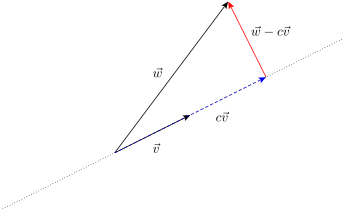
in other words:
Definition
Let w and v be two vectors,
Cross Product
- Only in 3 dimensions => vector has 3 components
Definition
Let
Cross Product Template:
- Write u and v in a column:
- copy the first two leftmost entries of u and v.
- calculate the first entry of u x v, starting with u_2 in an x shape.
- calculate the second entry of u x v.
- calculate the third entry of u x v.
Properties:
Geometric Properties:
with being the angle between u an v. - right hand rule for
: - index finger: first vector (u)
- middle finger: second vector (v)
- thumb: cross product (
)

Lines and Planes
Definition
The line through P parallel to v is given by
where
- The vector p is called a support vector of l.
- the vector v is called a direction vector of l.
Planes in
- A normal vector of M is a non-zero vector orthogonal to M.
- A plane is determined by:
- three points, not on one line.
- by a support vector and a normal vector.
Planes by normal vector:
- If n is a normal vector of M, then for every
- if
this equation is called the normal equation of M.
Planes determined by three points:
How to find a normal vector: If P, Q and T are three points (not on a line), a normal vector of the plane can be found by taking a cross product, for example:
Method: Finding a plane equation from three points
The Plane W goes through three points A, B and C.
Determine an equation for the plane W of the form
- Find a normal vector for the plane W.
- Find a vector:
- Find another vector:
- Find the cross product of the vectors AB and AC (we use u and v for readability)
- Find a vector:
- Find a support vector p, which is a vector from the origin to any point on the plane.
- Choose
- Choose
- Replace n and p in
(x can be replaced with )