Lecture 1
Waterfall Model
The waterfall model is an approach to the process of a software project, it can be broken down into the following sequential steps:
The waterfall model is characterized by being:
- Very structured (sequential)
- Emphasis is placed on the documentation in every software development step.
Advantages
- Requirements are known before starting the design.
- The design of the whole system is known before building the components.
- There are reviews at the end of each phase to enhance customer involvement.
- Extensive Documentation. (may be an advantage)
Disadvantages
- Requirements must be clear and consistent.
- Prone to delays.
- Too much documentation.
- Hard to estimate the progress in the project.+ Milestones based on documentation
- Large efforts on integration and testing at the end.
- We can’t demonstrate system features until the end.
- Unfriendly to changes in the requirements.
- Unfriendly to customer involvement.
Agile
Agile is a Philosophy or Paradigm of software development. Various Models fall under agile:
- RAD
- UP
- SCRUM
- XP
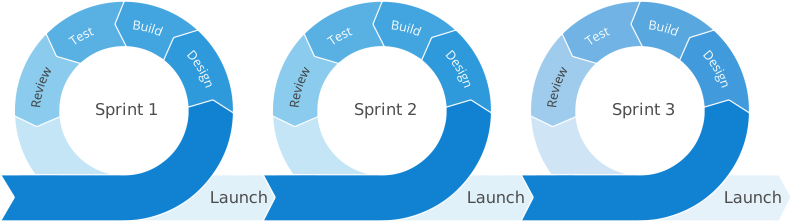
Agile has sprints of fixed durations. At the end of each sprint a new version of the product can be deployed.
Values
The values of agile software development are:
- Individuals and interactions over processes and tools. 👨 > 🔧
- Working software over comprehensive documentation. 💽 > 📘
- Customer collaboration over contract negotiation. 🔃 > 📃
- Responding to change over following a plan. ➿ > ➡️
Principles
The principles of agile software development are:
- Customer satisfaction by early and continuous delivery of valuable software.
- Welcome changing requirements, even in late development.
- Deliver working software frequently (weeks rather than months)
- Close, daily cooperation between business people and developers
- Face-to-face conversation is the best form of communication (co-location)
- Working software is the primary measure of progress
Requirements Engineering
Requirements Analysis
Difficult Because:
- It is not clear what the system should do, or what the stakeholders want.
- It is not clear what technical challenges will come up and how to address these.
- It is difficult for the developer to understand the customer if they do not share domain knowledge.
WARNING
Impossible to do correctly if essential stakeholders are not involved.
The Inquiry Cycle
Agile Requirements
Between Sprint n-1 and Sprint n requirements are reconsidered.
- Evaluate the current version.
- Requirement discovery activity.
- Adapt and re-prioritize requirements.
- Freeze Requirements for next sprint.
Levels of Requirements
- Goal Level
- Example: "The system shall allow the hotel to handle an increase of 15 % in bookings without adding staff"
- Business Level
- Example: "The system will support the receptionist to prepare for the arrival of a tourist bus"
- System Level
- Example: "The system shall be able to record that a room is occupied for repair in a specific period"
- Design Level:
- "The system shall implement the information model defined by the class diagram in appendix X"
Types of Requirements
- Constraints
- Example: budget, due date, etc...
- Functional Requirements
- Typically user stories.
- Quality Requirements
User Stories
User Story Syntax
- As a
roleI wantgoal|desire - As a
roleI wantgoal|desire, so thatbenefit
Example:
As a customer I want to buy a theatre ticket online with my credit card.
Components of a user story:
- A short piece of text describing and representing the user story.
- Conversations between stakeholders to exchange perspectives on the user story.
- Acceptance criteria.
User Stories vs. Use Cases:
They describe roughly the same thing: an end user interacting with the system. Use cases are higher level, because user stories can be decomposed.
- Use Case is UML
- User Story is Agile
- Purposes:
- Use case: give high level overview of system functionalities.
- User story: describe a specific interaction from the perspective of a user.
Decomposing user stories:
A way to get user stories is to start with a high level story and decompose it:
For example Starting with:
- As a customer I want to buy a theatre ticket online with my credit card. Can be refined or decomposed a more detailed user stories:
- As a customer I want to log in to the theatre system.
- As a customer I want to select places for a performance.
- As a customer I want to buy selected tickets with my credit card.
Acceptance Criteria
- Acceptance criteria are formulated as tests, specifying cases the function should allow or not allow.
- It is Not a list of tests describing whether the implementation was done correctly.
Example:
- As a customer I want to buy the tickets with my credit card:
- Test with valid visa card
(pass)meets criteria - Test with expired visa card
(fail)because expired - Test with ING bank pass
(fail)because not a credit card
- Test with valid visa card
User Story Examples
Good:
- As a cashier I want to sell a set of tickets at the box office
- As administrative staff, I want to process an order form for theatre tickets
- As a cashier I want to print a duplicate ticket, so that customers who forgot to bring their tickets still can visit the performance
Bad:
- As a theatre director I want the administrative staff to process order forms for theatre tickets
- As a cashier, I want the printing of duplicate tickets to be simple and self-explanatory
- As a customer I want to pay with my credit card only if it is a real credit card (nota bank pass) and it has not expired
User Stories Evaluation
INVEST is an acronym for a set of guidelines to follow to create good user stories:
- Independent: the stories can be developed in any order.
- Negotiable: the details can be negotiated between the team and user or client.
- Valuable: the story should provide value to the "user" in the user story. If the story does not have discernable value it should not be done.
- Estimable: The time needed to implement should be roughly estimable.
- Small: The story should be small enough to be implemented in one sprint.
- Testable: the development team should be able to write acceptance criteria which can be used to determine when the story is "done".
Scenarios, Personas
Useful tools when the focus is on requirements discovery, rather than requirements specification.
Persona
an imaginary person (could be based on real people) who is a prototypical user of the system to be designed.
Persona example:
Jessica Brown
- age 26
- Born in Guatemala, lives in Groningen
- No Partner, No kids
- Marketing manager at LifeRips
- Speaks English, Spanish, Dutch
- Likes travelling
DILO
Day-in-the-life-of A DILO scenario shows how the use of the system is incorporated in a persona's daily activities.
Requirements discovery techniques:
- Brainstorming
- Interview
- Workshop
- Focus Group
- Documents
- Observation
- Studying similar companies or products
- Prototyping